Contact us for full Research Report
Nov 11, 2025
The Choice Architecture of Luxury

A senior partner's blueprint for deciding where artificial intelligence builds sustainable competitive advantage in global luxury hospitality — and where it never should.
Every luxury hotel group now has AI. Almost none of them have a way of deciding where it should — and should never — go.
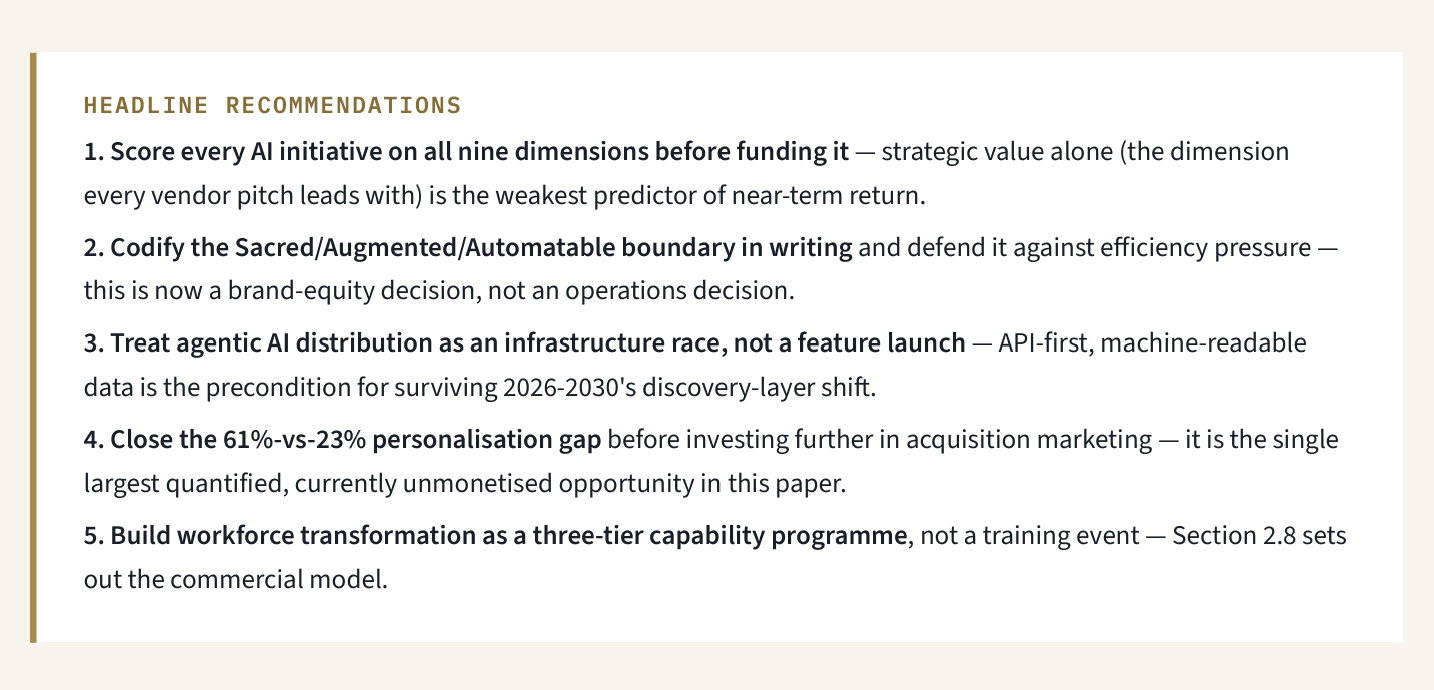
By 2026, AI-enabled revenue management, chatbots and basic personalisation have become table stakes across the luxury segment — table stakes, not differentiators. Meanwhile, agentic AI is arriving faster than most operating models can absorb it: IDC forecasts 30% of travel bookings will be executed autonomously by AI agents by 2030, and Google, OpenAI and Amazon have all announced agentic booking capability in 2026 alone. The strategic question luxury executives now face is no longer "should we adopt AI" — that question is settled — but "where, specifically, does AI create defensible advantage, and where does it corrode the very thing luxury guests are paying for." This paper answers that question with two original frameworks and two contrasting case studies.I-powered systems is a practical and future-ready decision.
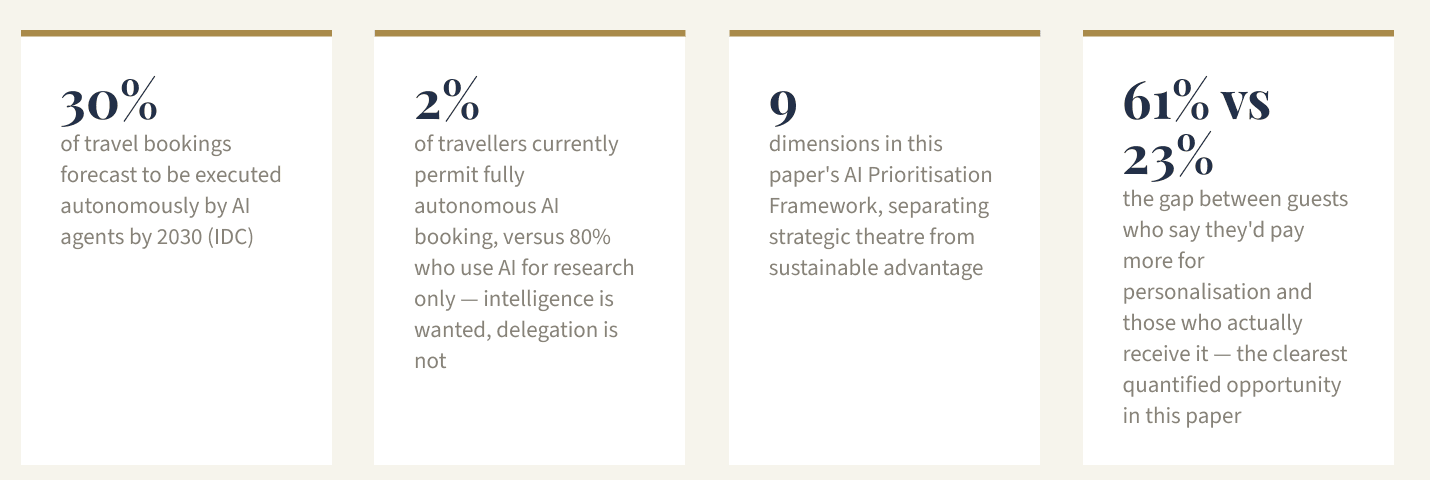
Section 2 builds a global AI taxonomy spanning twenty-one categories classified by business capability rather than vendor, an enterprise-wide value-chain maturity map, and a nine-dimension Prioritisation Framework that scores initiatives on business purpose, complexity, organisational readiness, data dependency, investment level, expected ROI, operational risk, strategic value and scalability — designed explicitly to stop executives comparing software demos and start them comparing sustainable advantage. Two case studies follow: a reconstruction of Marriott International's real, disclosed AI ecosystem, and an original consulting scenario — the "Aurelia Collection," a hypothetical ultra-luxury group — engineering a next-generation AI ecosystem under conservative, expected and optimistic five-year scenarios. The paper's sharpest argument is the Human-AI Decision Framework in Section 2.6: a three-tier model separating touchpoints that must remain Sacred (exclusively human, regardless of cost), those that should be Augmented (AI assisted, human-decided), and those that can be Automated without diminishing perceived luxury. Grounded in guest-psychology research showing luxury travellers are the least willing of any segment to delegate decisions to AI, this framework gives executives a defensible answer to the question boards increasingly ask: how do we know we haven't gone too far?