How it works
Jul 24, 2026
Making Sense of Artificial Intelligence

Executive Summary
Boardrooms now discuss ‘artificial intelligence’ as routinely as they discuss cash flow, yet the term means something different depending on who is speaking. A regulator, a software vendor and a computer scientist can use the identical word to describe three substantially different things. This research presents three linked, evidence-based studies designed to give business leaders a working command of what AI actually is, how it is built, and how the field arrived at its present moment — without requiring a technical background.
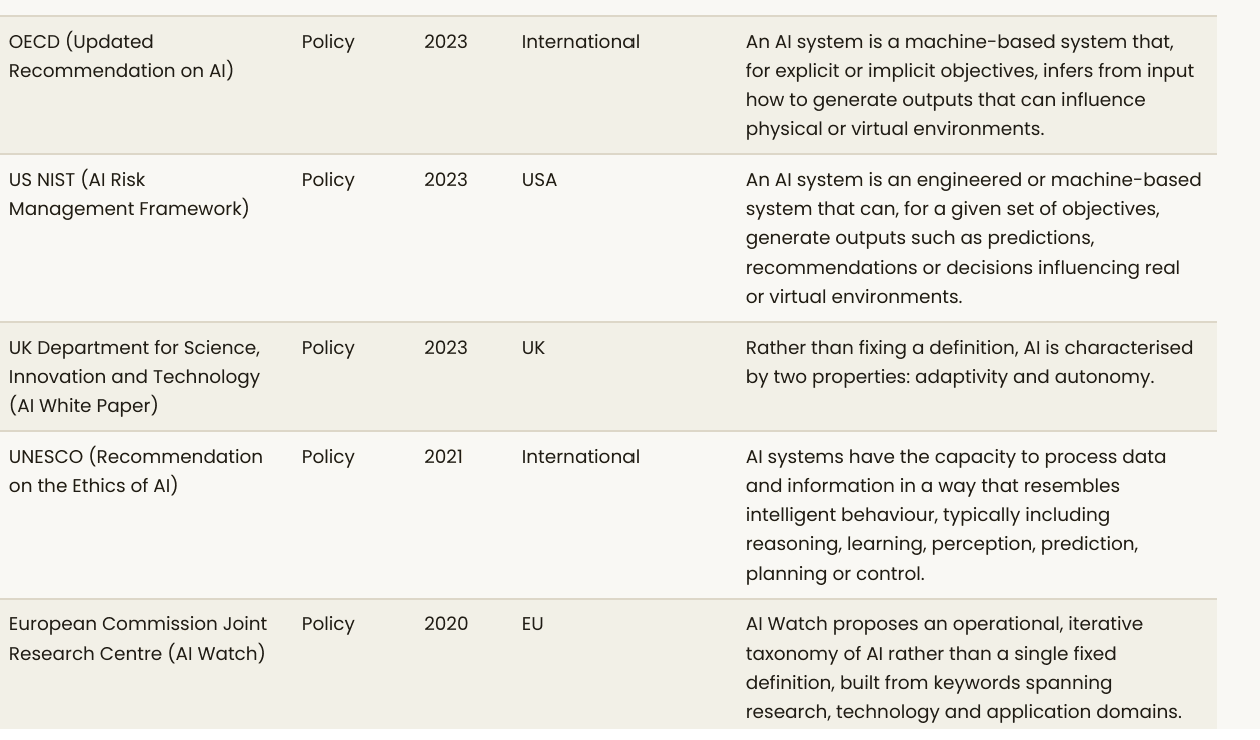
Study One analyses a purposively constructed corpus of 28 definitions of artificial intelligence, drawn evenly from academic, industry and policy sources published between 1950 and 2026. Coding each definition against eight recurring themes shows that the three sectors are not merely using different words for the same idea — they are emphasising systematically different things. Industry definitions lean heavily on human comparison, useful for marketing but legally imprecise. Policy definitions almost entirely avoid human comparison and instead foreground autonomy, data-dependence and task-generality — the properties a regulator actually needs to draw a legal boundary. Academic definitions sit in between, emphasising decision-making and rationality over data.
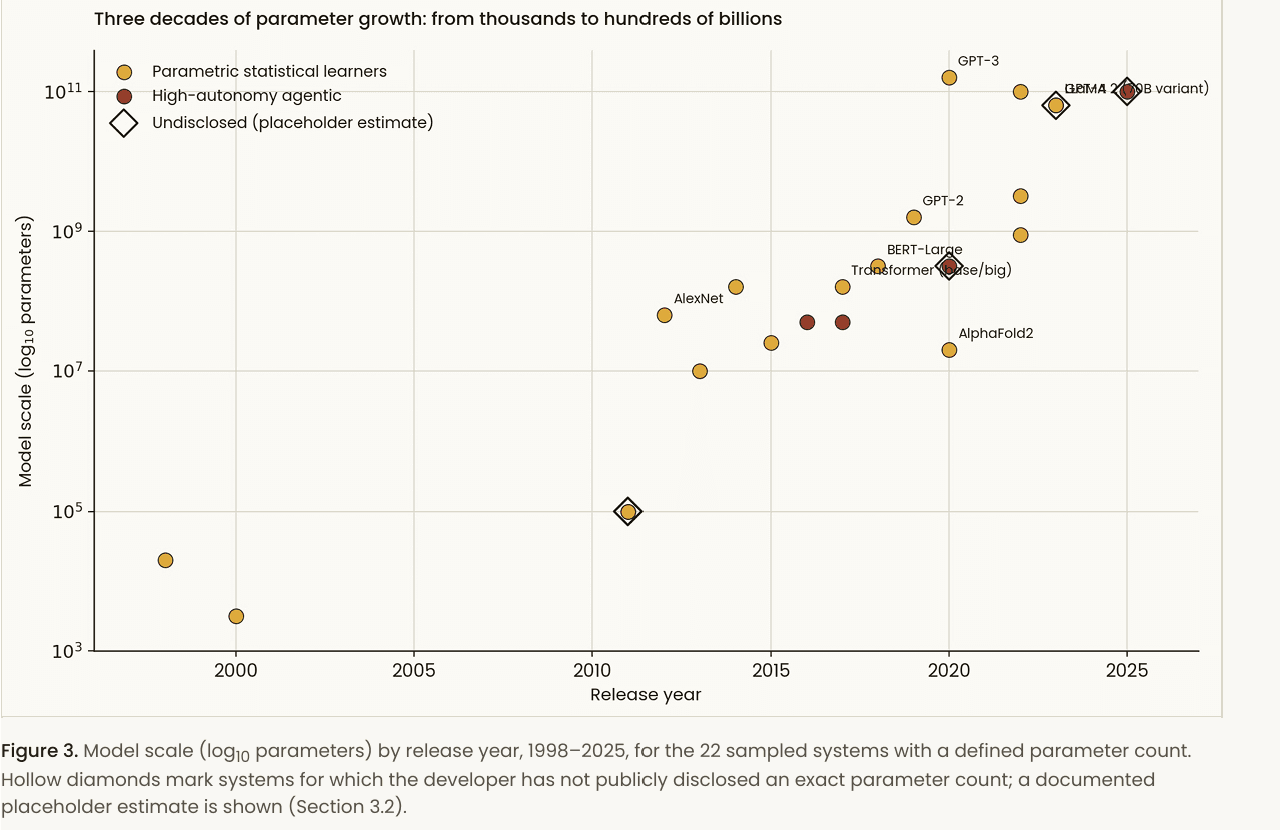
Study Two builds an empirical taxonomy from 27 well-documented AI systems spanning 1956 to 2025, coding each on its underlying paradigm, learning method, autonomy level, data modality and parameter scale. Statistical clustering, rather than expert opinion, sorts these systems into three clean groups: hand-coded symbolic systems with no learned parameters (dominant until the late 1990s); the broad family of parametric statistical learners that runs from early neural networks through to today's large language models; and a small, historically continuous cluster of high-autonomy agentic systems — game-playing agents, self-driving perception stacks and autonomous coding agents — that share a reinforcement-learning lineage and a willingness to act in the world, regardless of era or task. The practical implication is that autonomy, not scale or modernity, is what should trigger the closest scrutiny.
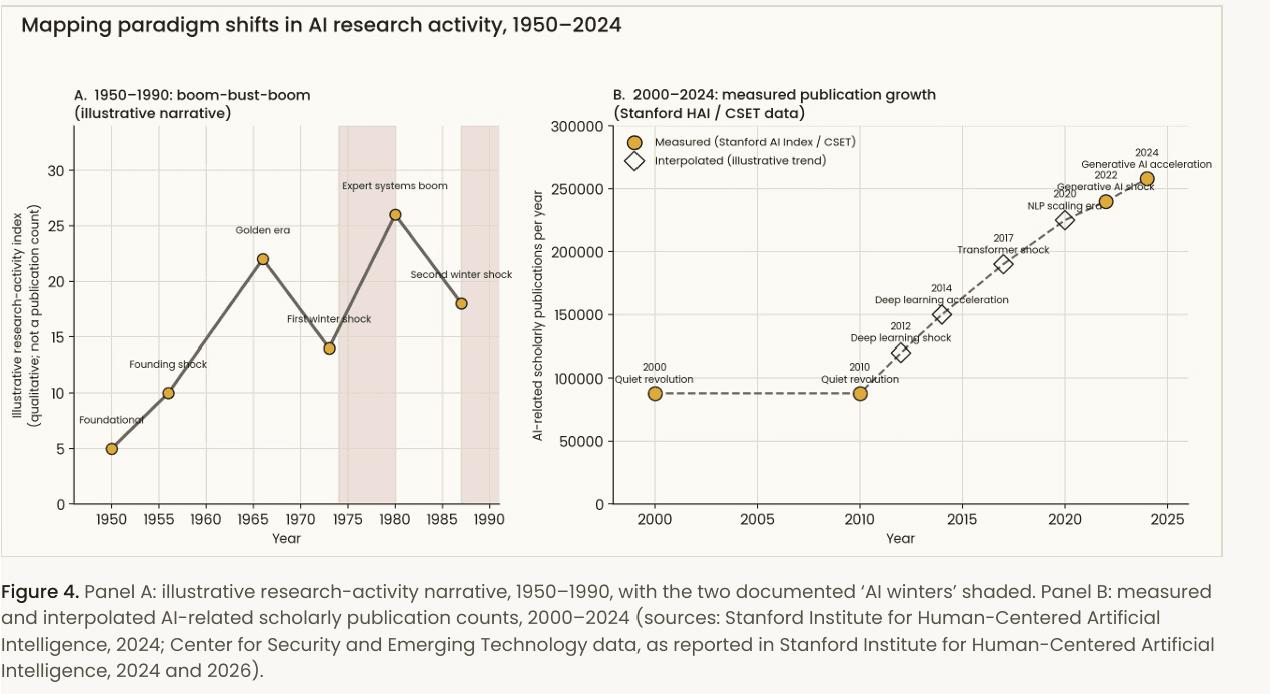
Study Three maps the history of AI against measured publication data from the Stanford AI Index and the Center for Security and Emerging Technology, cross-referenced with well-documented historical events. Global AI related scholarly output grew from roughly 88,000 papers in 2010 to more than 240,000 in 2022, and papers at five leading AI conferences rose tenfold between 2014 and 2024. These measured shifts line up with three qualitative shocks — the 1956 Dartmouth workshop, the 2012 deep-learning breakthrough, and the 2022 generative-AI moment — each followed by an acceleration in research output, separated by two earlier periods of contraction now known as the ‘AI winters’. Together, the three studies support one central message for business leaders: AI is not a single technology with a fixed definition, but a fast-moving family of systems whose meaning, shape and pace of change depend on who is describing it and why. The report closes with a practical framework for cutting through this ambiguity when evaluating vendors, drafting governance policy, or setting the pace of AI investment.